Boléro
Boléro is a one-movement orchestral piece by Maurice Ravel (1875–1937).
Maurice Ravel


Joseph-Maurice Ravel (March 7, 1875 – December 28, 1937) was a French composer known especially for his melodies, orchestral and instrumental textures and effects. Much of his and piano music, chamber music, vocal music orchestral music has entered the standard concert repertoire.
*********************************************************
Originally composed as a ballet commissioned by Russian ballerina Ida Rubinstein, the piece, is Ravel's most famous musical composition, which he considered trivial and once described as "a piece for orchestra without music.". Before Boléro, Ravel had composed
- Large scale ballets (such as Daphnis et Chloé, composed for the Ballets Russes 1909–1912),
- Suites for the ballet (such as the second orchestral version of Ma Mère l'Oye, 1912),
- One-movement dance pieces (such as La Valse, 1906–1920).
- Ravel had demonstrated an interest in composing re-styled dances, from his earliest successes (the 1895 Menuet and the 1899 Pavane) to his more mature works like Le tombeau de Couperin (which takes the format of a dance suite).
Boléro epitomises Ravel's preoccupation with restyling and reinventing dance movements. It was also one of the last pieces he composed before illness forced him into retirement: the two piano concertos and the Don Quichotte à Dulcinée song cycle were the only compositions that followed Boléro.
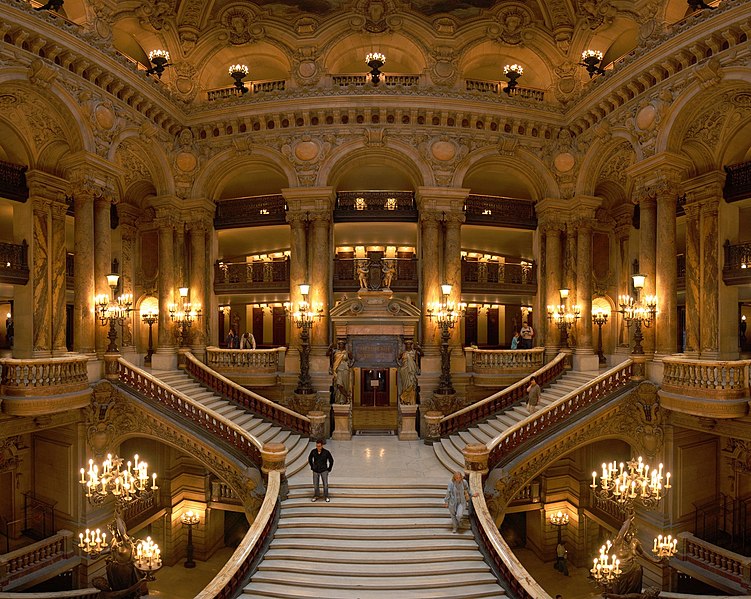
The composition was a sensational success when it was premiered at the Paris Opéra on November 22, 1928, with choreography by Bronislava Nijinska and designs by Alexandre Benois. The orchestra of the Opéra was conducted by Walther Straram.

The first recording was made by Piero Coppola in Paris for The Gramophone Company on January 8, 1930. The recording session was attended by Ravel. The very next day Ravel made his own recording for Polydor, conducting the Lamoureux Orchestra. That same year further recordings were made by Serge Koussevitzky with the Boston Symphony Orchestra and Willem Mengelberg with the Concertgebouw Orchestra.
Music
Boléro is "Ravel's most straightforward composition in any medium". The music is built over an unchanging ostinato rhythm played on one or more snare drums that remains constant throughout the piece:

On top of this rhythm is repeated a single theme, consisting of two eighteen-bar sections, each itself repeated twice. Tension is provided by the contrast between the steady percussive rhythm. Interest is maintained by constant re-orchestration of the theme, leading to a variety of timbres, and by a steady crescendo.
The melody is passed among different instruments. While the melody continues to be played in C throughout, from the middle onwards other instruments double it in different keys, involves
Just before the end (rehearsal number 18th), there is a sudden change of key to E major, though C major is reestablished after just eight bars. Six bars from the end, the bass drum, cymbals and tam-tam make their first entry, the English horn returns, and the trombones and both saxophones play raucous glissandi while the whole orchestra beats out the rhythm that has been played on the snare drum from the very first bar. Finally, the work descends from a dissonant D-flat chord to a C major chord.
- a horn playing the melody in C
- a celeste doubles it 2 and 3 octaves above
- two piccolos play the melody in the keys of G and E
Just before the end (rehearsal number 18th), there is a sudden change of key to E major, though C major is reestablished after just eight bars. Six bars from the end, the bass drum, cymbals and tam-tam make their first entry, the English horn returns, and the trombones and both saxophones play raucous glissandi while the whole orchestra beats out the rhythm that has been played on the snare drum from the very first bar. Finally, the work descends from a dissonant D-flat chord to a C major chord.
read this when you follow the video
| Part | Instruments that follow the snare drum's rhythm | Instruments that follow the theme to Boléro | Instruments that follow the quarter/eighth note rhythm |
|---|---|---|---|
| 1st | none but 1st Snare drum | 1st Flute | Violas and Cellos |
| 2nd | 2nd Flute | 1st Clarinet | same |
| 3rd | 1st Flute | 1st Bassoon | same, and harp |
| 4th | 2nd Flute | E-flat clarinet | same |
| 5th | 1st and 2nd Bassoons | Oboe d'amore | String quartet with basses except 1st violins |
| 6th | 1st Horn | 1st Flute & 1st Trumpet (con sordino) | Strings with basses except 2nd violins |
| 7th | 2nd Trumpet (con sordino) | Tenor saxophone | 1st and 2nd Flutes, and strings |
| 8th | 1st Trumpet (sord) | Sopranino saxophone, later, interchanges with the Soprano saxophone | Strings, 1st & 2nd Oboes and Cor anglais |
| 9th | 1st Flute & 2nd Horn | 1st Horn, 2 Piccolos, Celesta | Strings, harp, 1st and 2nd bassoons andBass clarinet. |
| 10th | 3rd Trumpet (con sordino), 2nd Horn, and Violins and Violas | 1st Oboe, Oboe d'amore, Cor anglais and 1st & 2nd Clarinets | 1st & 2nd trumpets (both sord), harp, bass clarinet and 1st and 2nd bassoons |
| 11th | Violas (arco), 1st Flute and 2nd Horn | 1st Trombone | Rest of the strings, 1st and 2nd Clarinets, bass clarinet, harp and Contrabassoon |
| 12th | 1st Trumpet (senza sordino), 4th Horn and 2nd Violins (arco) | All wind instruments (except Bassoon and Contrabassoon), and Tenor Saxophone | Strings but 2nd Violins, harp, bass clarinet ,Bassoon and Contrabassoon |
| 13th | 1st and 2nd Horns | Flutes, Oboes and Clarinets (both 1 & 2), Piccolo, 1st Violins (arco) | Strings (still pizz, again), 3rd and 4th Horns, Timpani and 1st and 2nd Bassoons & Contrabassoon |
| 14th | 3rd and 4th Horns | same, and with Cor anglais, Tenor Saxophone, and 2nd Violins | Sopranino saxophone, Harp, Bassoon, Contrabassoon, 1st and 2nd Horns and Timpani. |
| 15th | 1st and 2nd Horns, later, 2nd Horn will turn to the theme (interchanging with the 1st Trumpet) | All wind instruments except clarinets, bassoon and contrabassoon, 1st Trumpet and 1st and 2nd Violins, later, Violas and Bass Clarinet (later) | 1st & 2nd Clarinets, 1st & 2nd Bassoons, Contrabassoon, Tenor and Sopranino Saxophone, 1st and 2nd Trombone, Tuba, Timpani Harp and some Strings. |
| 16th | 1st, 2nd, 3rd, and 4th Horns | All woodwinds except Bassoons and Contrabassoon, Sopranino Saxophone, 1st Trombone, 1st and 2nd Violins, Violas and Cellos, later, the Sopranino saxophone will interchange the theme with the Tenor Saxophone. | Bass Clarinet(later, turning to the theme), Bassoon, Contrabassoon, 1st, 2nd and 3rd Trumpet, 2nd and 3rd Trombones, Tuba, Timpani, Harp and Double bass. |
| 17th | 1st & 2nd Oboes, 1st & 2nd Clarinets, all Horns, 2nd Violins, Violas and Cellos, added with another Snare drum playing throughout. | 1st & 2nd Flutes*, Piccolo*, 1st, 2nd and 3rd Trumpets*,Piccolo trumpet, Sopranino and Tenor Saxophone, and 1st Violins | Bass Clarinet, Bassoons, Contrabassoon, 1st, 2nd and 3rd Trombones, Tuba, Timpani, Harp and Double Bass |
| 18th | same | same but the 1st Trombone in going with the theme | the same but not the 1st Trombone |
| Finale | All instruments except listed in the quarter/eighth rhythm on the right | Glissando: 1st, 2nd, 3rd Trombones and Sopranino and Tenor Saxophone | Oboes, Clarinets, Cor Anglais, Bassoons, Contrabassoon, Tuba, Timpani, Double Bass, and Bass Drum, Cymbals and Tam-tam |
*The piccolo and flutes play the snare drum's theme, and the trumpets play the three-eighth note rhythm before the start and after the end of 17th.
The accompaniment becomes gradually thicker and louder until the whole orchestra is playing at the very end. : D
Tempo and duration
The tempo indication in the score is Tempo di Bolero, moderato assai (very moderate).
In Ravel's own copy of the score, the printed metronome mark from the first~
- 76 per quarter is crossed out and 66 is substituted.
- Later editions of the score suggest a tempo of 72.
- Ravel's own recording from January 1930 starts at around 66 per quarter,
- slightly slowing down later on to 60–63.Its total duration is 15 minutes 50 seconds.
- Coppola's first recording, duration of 15 minutes 40 seconds. Ravel said that the piece lasts 17 minutes.
- the slowest recordings, such as that by Ravel's associate Pedro de Freitas Branco, extending well over 18 minutes
- the fastest, such as Leopold Stokowski's 1940 recording with the All American Youth Orchestra, approaching 12 minutes.
- Toscanini's 1939 recording with the NBC Symphony Orchestra has a duration of 13 minutes 25 seconds. (Gosh!! so fast)
Ravel's preference for a slower tempo. An average performance will last in the area of fifteen minutes.
That's all : D
by. heidi <3

No comments:
Post a Comment